
The smoke-free nicotine market moves fast — faster, arguably, than any consumer category in Britain right now — and 2026 has been a pivotal year. A disposables ban that reshaped vaping, a vaping duty on the horizon, nicotine pouches going mainstream and newly regulated, brands rising and consolidating, and a regulatory framework tightening across the board. For anyone who uses these products, or is thinking about switching, understanding where the market is heading isn’t idle curiosity — it affects what you buy, what you pay, and what stays available. This article is the state-of-the-market overview for 2026: the big trends shaping vaping and pouches, what’s driving them, and what they mean for you as a user. Consider it the briefing that helps you make sense of a category that’s changing under your feet, so your choices are informed by where things are going, not just where they’ve been.
Trend One: The Post-Disposable Consolidation
The defining trend remains the aftermath of the June 2025 disposables ban, and by 2026 the dust has settled into a clear pattern: the market has consolidated around rechargeable pod systems. Prefilled pod kits — a rechargeable device with sealed, ready-filled pods — have become the default replacement for disposables, keeping the convenience while adding rechargeable batteries, screens, power modes and strength options the old format never had. Big-puff refill systems delivering thousands of puffs per pod dominate the mainstream, and the brands that pivoted cleanly to this format have thrived while those that couldn’t have faded. For users, this consolidation is good news: the replacement format is cheaper, less wasteful and more capable than what it replaced. Anyone shopping today will find the market organised around these rechargeable pod kits, which have become the settled standard rather than one option among many — the disposable era is genuinely over.
Trend Two: Pouches Go Mainstream
The second major trend is the mainstreaming of nicotine pouches. Once a niche product, pouches have surged into public awareness — roughly tripling in UK adult awareness in a few years — driven by their discretion, their tobacco-free legality, and a cultural moment that’s seen them adopted well beyond the traditional nicotine-user base. 2026 marks their regulatory coming-of-age too: the Tobacco and Vapes Act 2026 brings them under proper control with an 18+ age rule and marketing limits, closing the gap that previously left them loosely governed. For users, pouches’ rise means more choice, more flavours, more availability and — with regulation — more legitimacy and stability. It also means the confusion between pouches and banned snus is more consequential than ever, since more people are using them; for clarity on the distinction, see what is snus, and remember the legal product remains the tobacco-free pouch, and understanding that distinction matters as the category grows. Pouches are no longer a fringe curiosity but a mainstream pillar of the smoke-free market.
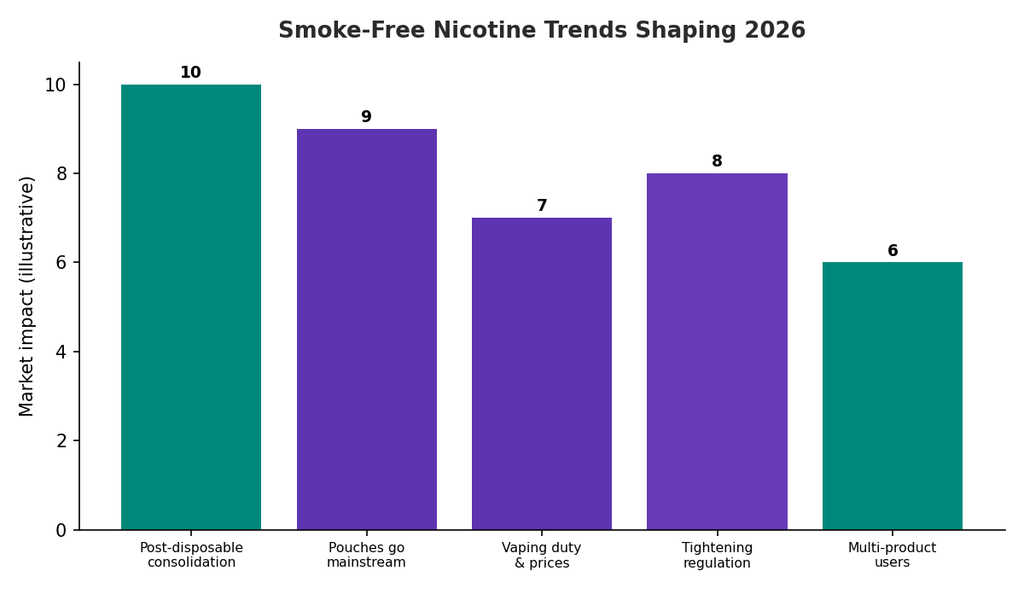
The forces shaping smoke-free nicotine in 2026 and beyond.
Trend Three: The Duty and the Price Shift
Looming over the vaping side of the market is the vaping products duty, taking effect from October 2026 — an excise tax on e-liquid charged per millilitre. It’s the first time vaping has faced this kind of taxation, and it marks a shift: vaping will get more expensive, though from such a low base that it remains dramatically cheaper than smoking. The duty’s deeper effect is structural — it widens the gap between legitimate duty-paid stock and the illicit market, making the buy-genuine habit a tax-compliance matter as well as a safety one, and it slightly shifts the relative economics toward refillable vaping and pouches, neither hit the same way. For users, the practical response is to buy from established retailers, consider stocking sealed e-liquid before the duty within its shelf life, and treat the change as a modest price step rather than a reason to abandon a format that still saves them enormously versus smoking.
Trend Four: Tightening Regulation Across the Board
A unifying trend runs through everything: regulation is tightening across the whole smoke-free category, driven by the twin goals of preserving adult access while closing off youth access. The Tobacco and Vapes Act 2026 creates powers over flavours, packaging, displays and advertising across both vaping and pouches, with the direction toward plainer, less youth-appealing presentation. Age enforcement is sharpening. The illicit market is being squeezed by both enforcement and the incoming duty. For responsible adult users buying from established retailers, none of this is threatening — the compliant mainstream is the protected path, and most of the changes affect marketing and presentation rather than product availability. But it does mean the category is maturing from the wild-growth phase into a more controlled, legitimate one, which in the long run supports its stability and its standing as a recognised harm-reduction option for adult smokers.
Trend Five: The Multi-Product User
A quieter but significant trend is the rise of the multi-product user — people who no longer pick a single smoke-free product but combine them. The typical pattern is vaping for ritual moments and pouches for discreet ones, using each where it’s strongest and covering more of the day than either alone. This reflects a maturing market where users understand the products well enough to deploy them strategically rather than tribally, and it’s supported by the breadth of available options. For the individual, the multi-product approach often makes for a more robust switch, since fewer craving gaps mean fewer relapses. For the market, it means demand across categories rather than a zero-sum fight between them. The savvy 2026 user treats the smoke-free landscape as a toolkit to draw from, not a set of rival camps to join — matching the tool to the moment, which is exactly how the products are best used.
What It Means for You
Pull the trends together and the practical guidance for a user in 2026 is clear. Standardise on rechargeable pod systems for vaping — the settled, capable, cheaper format that replaced disposables, with established brands offering diverse flavour ranges (explore options like Hayati Flavours to find profiles that suit your preferences). Consider pouches for discretion, either solo or alongside vaping, now a mainstream and newly-legitimate option. Buy from established UK retailers to stay ahead of tightening regulation and the incoming duty, both of which reward the compliant mainstream and punish the illicit fringe. Get your strength right and buy genuine, as always. And understand the snus-versus-pouch distinction, which matters more as pouches grow. The market is maturing, consolidating and tightening — all of which favours the informed user buying legitimate products from reputable sources, and disadvantages the bargain-hunter drifting toward the grey market. Inform your choices by where the market’s going, and you’ll navigate 2026 and beyond smoothly.
What to Watch in 2027 and Beyond
Looking past 2026, a few developments are worth keeping an eye on. The full effects of the vaping duty will play out through 2027 as the market absorbs the price change and the illicit market is squeezed further. The flavour and packaging rules under the Tobacco and Vapes Act 2026 will take clearer shape, likely producing plainer presentation across the category. Nicotine pouches, newly regulated, will mature as a mainstream product, possibly with strength caps or other controls as regulators find their footing. And the hardware race in vaping will continue, with puff counts, screens and pod designs iterating further. None of this suggests upheaval on the scale of the disposables ban — the category is entering a more settled, regulated phase rather than another disruptive one. For users, the sensible posture is to stay with the mainstream compliant products and reputable retailers, which will adapt smoothly to whatever comes, while the grey market becomes progressively riskier. The direction of travel favours the informed, legitimate consumer, and that’s unlikely to change.
The Informed User’s Advantage
The overarching theme of the 2026 market is that it increasingly rewards the informed user and disadvantages the careless one. As regulation tightens and the duty raises the stakes, the gap between the compliant mainstream and the illicit fringe widens — and the users who understand the products, know the law, buy genuine from established retailers, and choose the settled formats will navigate every change smoothly, while bargain-hunters drifting toward the grey market face rising risk and dwindling legitimacy. This is, on balance, a healthy maturation: a category that was once wild and loosely governed is becoming a proper regulated market where informed adults can reliably access far-less-harmful alternatives to smoking. The practical advantage goes to those who treat their smoke-free nicotine use seriously — understanding what they’re buying, why, and from whom. Be that user, and the fast-moving market of 2026 and beyond becomes not a source of confusion but a well-stocked, well-regulated toolkit serving exactly the purpose it should.
Your Place in the Changing Market
To close, it’s worth reflecting on your own place in this evolving market as a user. The trends of 2026 — consolidation, mainstreaming, taxation, regulation — can feel like forces happening to you, but the informed user actually navigates them from a position of strength. By understanding the products, choosing the settled formats, knowing the law, and buying genuine from established retailers, you insulate yourself from nearly all the disruption while continuing to access the far-less-harmful alternatives that matter for staying off cigarettes. The changes reach the careless bargain-hunter as risk and confusion, but they reach the informed user as minor adjustments — a price step here, a tidier shelf there. This is the practical payoff of engaging seriously with the category rather than drifting through it: in a fast-moving market, knowledge is stability. Stay informed, buy legitimately, use the products thoughtfully, and you’ll find the smoke-free landscape of 2026 and beyond serves you reliably, whatever new trends and rules arrive — which is exactly the position any user should want to be in.
Frequently Asked Questions
What’s the biggest trend in 2026? The consolidation of vaping around rechargeable pod systems after the disposables ban, plus nicotine pouches going mainstream. Will vaping get more expensive? Somewhat, with the October 2026 duty, but it stays far cheaper than smoking. Are pouches regulated now? Yes — the Tobacco and Vapes Act 2026 brings an 18+ rule and marketing limits. Is the market getting more restricted? Regulation is tightening across the board, but mainstream adult products remain fully available. Should I stockpile before the duty? Modestly, within e-liquid’s shelf life, if you wish — but don’t overbuy. What’s the smartest approach for a user? Standardise on settled formats, buy genuine from established retailers, understand the law, and you’ll navigate every change smoothly. Is now a good time to switch from smoking? As good as any — the tools are mature, effective and far cheaper than cigarettes.
The Market Is Maturing in Users’ Favour
Step back from the individual trends and a reassuring pattern emerges: the smoke-free market is maturing in ways that broadly favour the informed adult user. Consolidation around capable rechargeable pod systems gave everyone a cheaper, better replacement for disposables. Pouches going mainstream and gaining regulation brought a useful discreet option in from the fringe. Even the tightening rules and the incoming duty, while adding friction, mostly squeeze the illicit market and youth appeal rather than restricting legitimate adult access. The category is growing up from a wild, loosely-governed phase into a properly regulated market where far-less-harmful alternatives to smoking are reliably available to adults who want them. The users who benefit most are those who engage with the legitimate end of it — and the direction of travel keeps rewarding them. For anyone using these products to stay off cigarettes, that’s an encouraging place for the market to be heading, and a good reason to stay in its mainstream.
The Bottom Line
Smoke-free nicotine in 2026 is a market in rapid, mostly positive evolution: consolidated around capable rechargeable pod systems, energised by mainstream nicotine pouches, reshaped by an incoming vaping duty, tightened by across-the-board regulation, and increasingly used by savvy multi-product consumers who match the tool to the moment. For users, the through-line is that an informed approach — standardising on the settled formats, buying genuine from established retailers, understanding the products and the law — navigates all of it comfortably, while the fundamentals hold: these products remain far less harmful and far cheaper than the smoking they replace. Stay informed, buy legitimate, and treat the landscape as the maturing toolkit it’s becoming. As always: everything here is for adults aged 18 and over who already smoke or use nicotine, as far less harmful alternatives to cigarettes — and for anyone else, the best trend to follow is the one away from nicotine entirely.